Saudi .sa for Capital Credibility
A .sa address tells customers in Riyadh and across the Kingdom that they are dealing with a Saudi organisation. It suits companies whose main market, partners and staff are based inside Saudi Arabia.


Try .sa, .com, .net or any other extension.
Your domain name carries your organisation's identity into every email, proposal, invoice and search result. For a company based in Riyadh, a .sa address signals a Saudi presence to customers and partners, while a global extension such as .com helps when you work with international clients. Many capital-city organisations hold both, together with a few defensive registrations that keep lookalike names out of the wrong hands.
Use the availability search on this page to check .sa and other extensions. Prices are shown at checkout or provided on request, because they vary by extension and registry. Once your domain is registered, connect it to your Riyadh Server infrastructure, whether that is a KVM VPS, a dedicated Xeon server or a Windows RDP desktop. This guide explains Saudi registry requirements in general terms, naming choices, brand protection, DNS records, ownership and renewal practices for Riyadh organisations.
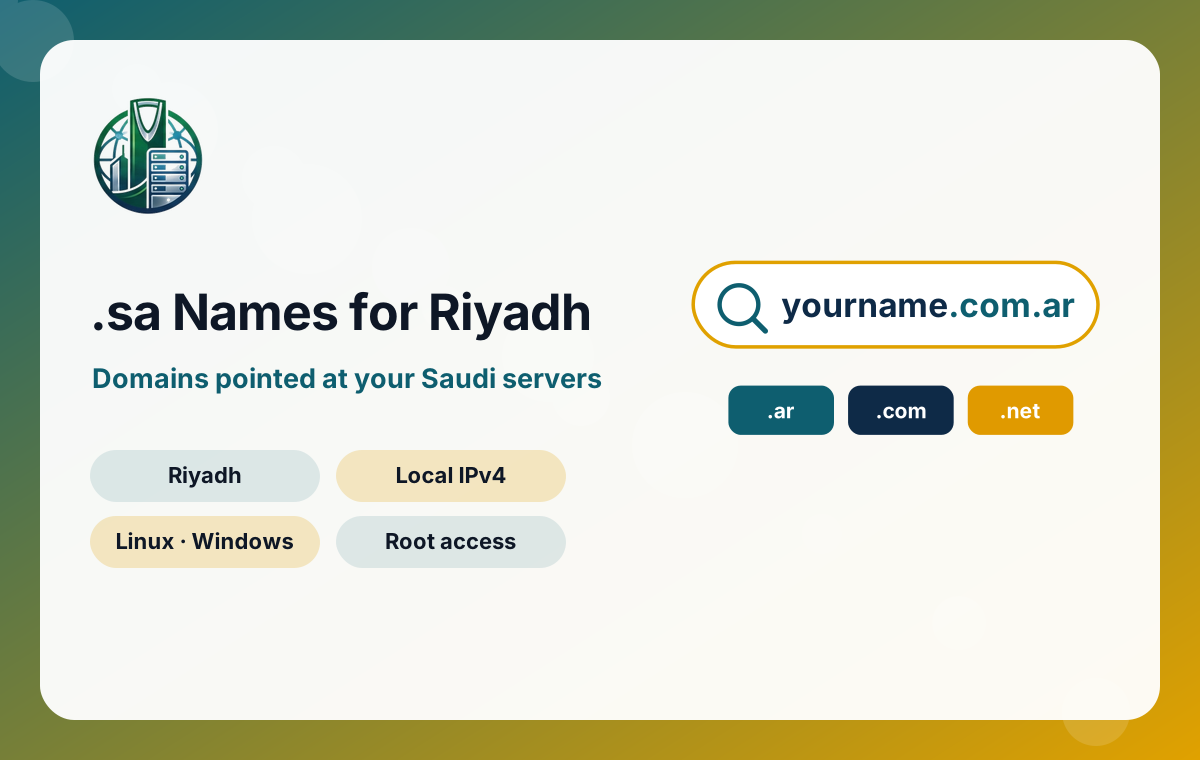
A .sa address tells customers in Riyadh and across the Kingdom that they are dealing with a Saudi organisation. It suits companies whose main market, partners and staff are based inside Saudi Arabia.
Global extensions such as .com, .net or newer generic names help organisations that sell abroad or work with international partners. Many Riyadh companies register one alongside their .sa name and redirect it.
Type the name you want into the search on this page to check whether it is free across several extensions. Pricing for each extension is displayed at checkout or provided on request.
Point A, AAAA, MX and TXT records at your VPS, dedicated server or RDP desktop so the website, mail and services resolve to infrastructure located inside Saudi Arabia from the first day.
Register common misspellings and alternative extensions of your brand so that they cannot be used for phishing emails or fake websites aimed at your customers, staff or suppliers.
If a record does not behave as expected, open a support ticket from the client area. An engineer can review your domain and server setup and reply in writing, so the explanation is kept for later.
Country-code domains carry meaning. When a visitor in Riyadh sees a .sa address, they understand that the organisation is connected to the Kingdom, which can increase trust for local services, B2B suppliers and companies that bid for work with large Saudi organisations. Search engines also treat a country-code domain as a signal that the site targets that country.
A .sa domain is a good fit when:
A global extension may be preferable when your business is primarily international, when you plan to expand across several countries under one site, or when a short memorable .com is available. For most capital-city organisations, the answer is not either-or: hold the .sa for local identity and a global name for international reach, then decide which one is primary and redirect the other.
Alongside registrations directly under .sa, the Saudi namespace includes second-level categories such as .com.sa, which many commercial organisations have used for years. Other categories exist for particular kinds of organisation, and some are restricted to eligible entities only, such as government, educational or medical bodies.
When choosing between options, consider:
Category rules are set by the registry and can change, so we confirm eligibility for your chosen name when you place the order.
Each country-code registry sets its own policies, and the Saudi registry is no exception. Requirements are updated from time to time, so we describe them in general terms here and confirm the current position when you order.
In general, you should be prepared for some or all of the following:
Practical tip: gather your company's official documents before ordering, and make sure the registrant name is your organisation rather than an individual employee or an agency. That avoids delays during registration and complications later if staff change. For a global extension such as .com, registration is usually immediate and requires only accurate contact details.
A good domain is short, easy to say over the phone and hard to misspell. A few principles help capital-city organisations choose well:
Search a shortlist of names on this page before committing to logos, signage or printed material.
Criminals register domains that resemble well-known brands to send phishing emails, collect passwords or fake invoices. Financial services and companies that handle payments are frequent targets, but any organisation with suppliers and customers can be impersonated.
A sensible defensive portfolio for a Riyadh organisation might include:
Point all of these at your main website with permanent redirects, and do not configure mail for them except to reject it. Pair registration with technical controls: publish a strict DMARC policy on your real domain so receivers reject spoofed mail, and monitor for newly registered names similar to yours. Tell staff and customers which domains you use for invoices and payment links, so they can spot anything unusual.
Defensive registrations cost far less than recovering from a successful impersonation campaign.
Once your domain is registered, DNS records tell the internet where each service lives. Typical records for a Riyadh organisation are:
An A record points the domain to your VPS or dedicated server's IPv4 address. Add a second record or a CNAME for the www version. If your server has IPv6, add an AAAA record as well.
MX records tell senders where to deliver email. A TXT record for SPF lists the servers allowed to send for your domain, a DKIM record publishes the key used to sign messages, and a DMARC record sets the policy for mail that fails those checks. These matter whether mail runs on your VPS or on a separate service.
Subdomains such as portal, api or vpn can point to different servers, for example an API on a Riyadh VPS and a remote desktop on an RDP package. TXT records also verify domain ownership for search consoles, certificate authorities and cloud services.
Keep a written list of every record and its purpose. When someone later wonders why a record exists, the answer is on file.
DNS can be managed in several places, and the choice affects how easy changes are and how resilient resolution is.
Whichever you choose, limit who can change records and protect the account with two-factor authentication. A single malicious change to your MX or A records can redirect email or the website, so DNS access deserves the same care as server administrator access. Lower TTL values before planned migrations and raise them again afterwards for stability.
A surprising number of organisations discover, years later, that their main domain is registered to a former employee, a web designer who has moved on or a personal email address nobody checks. Recovering it can be slow and stressful.
Good practice for Riyadh companies:
These steps matter even more for suppliers to large organisations and regulated businesses, where a lost domain could interrupt communications with clients at a critical moment.
Riyadh is home to many business groups with several subsidiaries, brands and joint ventures. Planning the domain structure early avoids a confusing mix later.
Common patterns include:
For email, decide whether staff in every subsidiary use the group domain or their brand's own domain, and configure SPF, DKIM and DMARC for each. Track every domain in a single register with its owner, expiry date and purpose. When a subsidiary is restructured, the register shows instantly which domains, records and mailboxes are affected.
An expired domain takes down the website, email and every service that depends on it, often without warning to the people who notice first: customers. Renewal is simple, but only if someone owns the task.
Transfers follow similar logic. If you want to move an existing domain to us, unlock it at the current registrar, obtain the authorisation code if the extension uses one, and make sure the registrant email is reachable. Rules for country-code domains can differ from generic ones, so ask through a ticket before starting a .sa transfer.
We do not publish a fixed domain price list, because prices depend on the extension and on registry fees that can change. The price for your chosen name is displayed at checkout, or you can request a quote through a sales ticket, which is useful when you plan to register several defensive names at once.
Domains are ordered through the client area at control.serverslot.com, the platform through which Riyadh Server services are provisioned and supported. Accepted payment methods are crypto, Visa, Mastercard, PayPal and bank transfer.
Once the domain is active, connect it to your hosting: a Riyadh KVM VPS for websites and applications, a dedicated Xeon server for heavier systems, or a Windows RDP desktop reached through a friendly hostname. For website setup guidance, see the website hosting guide.
Yes. Use the availability search on this page to check your preferred name. Saudi registry policies apply, and some names or categories require supporting information about your organisation. We confirm the current requirements for your chosen name when you place the order, and pricing is shown at checkout.
Requirements depend on the name and category and can change over time. Commonly, you need registrant details that match your organisation's official records, and some categories ask for supporting documents such as commercial registration or trademark evidence. Prepare these before ordering to avoid delays.
Domain prices vary by extension and depend on registry fees that can change. Rather than publish figures that could become outdated, we show the exact price for your chosen name at checkout. For several registrations at once, request a quote through a sales ticket.
Start with your name under .sa, the relevant second-level category and .com, then add the most likely misspellings and transliteration variants. Redirect them to your main site and publish a strict DMARC policy on your primary domain so spoofed email is rejected by receiving servers.
An A record points the domain and its www version to your server's IPv4 address. MX records direct email, while TXT records publish SPF, DKIM and DMARC policies. Subdomains such as portal or api can point to other servers, including dedicated machines or RDP desktops.
Register the domain in your organisation's legal name, with a role-based contact email monitored by several people. Store account credentials in a company password manager, record the expiry date in your IT asset register and make sure agencies agree that the client owns the domain.
Transfers are often possible, but rules for country-code domains can differ from generic extensions. Unlock the domain at the current registrar, confirm the registrant email works and obtain any authorisation code required. Open a ticket before starting a .sa transfer so we can confirm the current process.
Renew for multiple years where possible, enable automatic renewal with a current payment method, send notices to a shared mailbox and add expiry dates to your IT calendar. Review your full domain portfolio once a year to drop unused names and protect new brands.
Tell us where your users are and what you plan to run. An engineer will reply with a recommendation through the ticket system.
We use essential cookies to run this site and remember your settings. With your consent we also use optional cookies for analytics. Read our privacy terms.